← Experiments
WIJZER
An open letter to Apple
23 August 2026
A watch face that cannot be built

The day has two halves. Your watch knows one.

wijzer is a 24-hour dial that draws your calendar and your sky together — meetings as arcs, the sun, moon and tide resting at their true hours — so you can see how much of the day is still yours. It works. It cannot ship, because watchOS does not open the face.

Sky computed for Thu 30 Jul 2026 41.49° N · 71.31° W Sunrise 5:38 Sunset 8:07 Moonrise 8:50 Moon 98%, one day past full
I. The dial

One revolution is one day.

Midnight at the top, noon at the bottom, the hand going round once. Your meetings sit inside as arcs. Under the rim, as if the watch had been laid down on its own almanac, rest the sun, the moon and the tide — each on the hour it actually happens. You stop reading a list and start reading a shape.

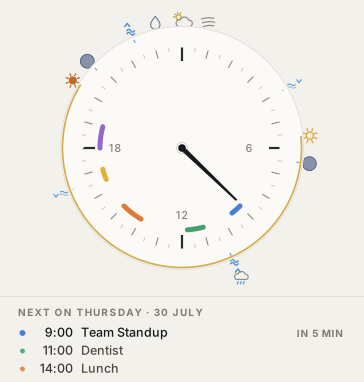
The wijzer dial for Thursday 30 July 2026, annotated: midnight at the top; meetings as arcs; one hand at 8:55; sunrise at 5:38; moonrise at 8:50 PM; the brass daylight arc; high tide at 10:22 in rain; and the next three meetings listed below the dial. MIDNIGHT, AT THE TOP Twenty-four hours on one turn. The night’sconditions gather here: humidity, sky, wind. SUNRISE 5:38 AM Sun, moon and tide rest under the rim atthe hours they occur. Computed, not drawn. ONE HAND · 8:55 AM A single black hand carries the time alone.Standup is the blue arc it is about to touch. HIGH TIDE 10:22 AM, IN RAIN Forecast weather rides the tide it meets:two glyphs, one spoke, one moment. MOONRISE 8:50 PM 43 minutes after sunset, 98% lit — whata moon one day past full actually does. WHAT YOU OWE Meetings as arcs in their calendar colors.Dinner with Sarah, six to seven. THE LIGHT A brass arc on the rim runs from sunriseto sunset: the daylight that is left. WHAT IS NEXT The next three entries, in plain words,for the glance that has no time for dials.
The wijzer dial for Thursday 30 July 2026 at 8:55 AM. 1 2 3 4 5 6 7 8
  1. 1Midnight, at the topTwenty-four hours on one turn; the night’s conditions gather here.
  2. 2What you oweMeetings as arcs in their calendar colors — here, dinner, six to seven.
  3. 3One hand · 8:55 AMAbout to touch the blue arc: standup in five minutes.
  4. 4Sunrise 5:38 AMSun, moon and tide rest under the rim at their true hours.
  5. 5Moonrise 8:50 PM43 minutes after sunset, 98% lit — one day past full.
  6. 6The lightThe brass arc on the rim runs sunrise to sunset.
  7. 7High tide 10:22 AM, in rainWeather rides the tide it meets: one spoke, one moment.
  8. 8What is nextThe next three entries, in plain words.
Plate I · the face at 1.5× its 364-point study size Sunrise, sunset, moonrise, moonset and phase from the ephemeris; tide heights illustrative.
WIJZER23 August 2026 · Re: the watch face

Dear Apple,

You have built the best calendar I wear. The next event, the minutes until it, the tap on the wrist that arrives exactly when it should. I am not writing to complain about any of it.

I am writing because a calendar is a ledger of what you owe other people. It knows the meeting and not the morning — not when the sun comes up, when the tide turns, or whether the moon will be out when you finally close the laptop. A watch built only on the calendar shows a full day and an empty one and makes them look identical. And every wellbeing feature grades me afterwards; none of them help with the question asked in the morning: how much of today is mine, and when?

Balance is not a number you close at midnight. It is seeing the whole shape of a day early enough to do something about it.

The Thursday on this page

Rather than argue the case, here is an ordinary working day: Thursday, 30 July 2026, at 41.49° N, 71.31° W on the New England coast. The sky half comes out of the ephemeris for that date and place — computed, not invented.

The calendar

The half you already have. Read as a list, a full day with no room in it.

09:00Team standup30 min
11:00Dentist45 min
14:00Lunch1 hr
16:30Call Mom30 min
18:00Dinner with Sarah1 hr

The sky & the sea

The half no calendar knows. None of it is on your wrist today.

05:38Sunrise68°
06:28Moonset98% lit
10:22High tide, showers4.2 ft
16:37Low tide0.0 ft
20:07Sunset76°
20:50Moonrise98% lit
The finding

Dinner ends around seven. Forty-three minutes after sunset, a moon one day past full rises over a spring tide — the widest range of the month. Neither half of the day contains that fact. Only the dial does, on the same revolution as the standup.
Please turn over — and try it on →

II. Try the faces

One watch. Three faces. A swipe apart.

On the wrist the faces are one surface: the day, the shore, the schedule. This is the working prototype at true proportions — swipe the screen, turn the crown, or pick a face.

  1. i.The Dial Everything at once: arcs for the meetings, glyphs for the sky, the tide at the rim, and one black hand carrying the time. 8:55 Thursday. Standup in five minutes; the tide turns at 10:22, and it will be raining when it does.
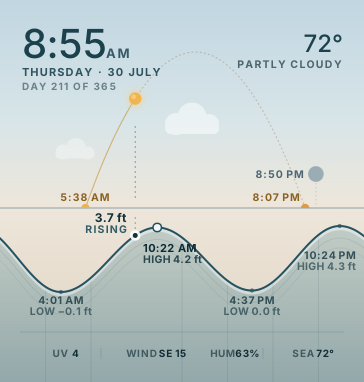
  2. ii.Outdoor The meetings fall away. The sun crosses its arc above a true tide curve, cosine-interpolated between the day’s four extremes. 3.7 feet and rising. High at 10:22, then the long fall to 4:37. The moon waits for its 8:50 rise.
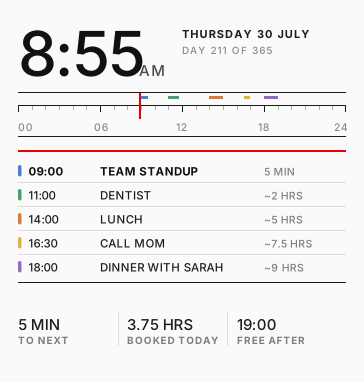
  3. iii.Work The sky falls away. Five slots, a red rule for now, and how long you have — on a Swiss grid where the hour axis and the type share columns. The mode you leave, not the one you live in. 3.75 hours booked of 24; free after seven.
The Dial face: a 24-hour dial at 8:55 AM with meetings as arcs and the sun, moon and tides at their true hours, the next three meetings listed below.
The Outdoor face: 8:55 AM, 72° partly cloudy; the sun's arc from 5:38 AM to 8:07 PM above a tide curve, 3.7 feet and rising toward a 4.2 foot high at 10:22 AM; moonrise 8:50 PM.
The Work face: 8:55 AM, a 24-hour axis with five calendar slots and a red rule for now; standup in 5 minutes, 3.75 hours booked today, free after 19:00.
Drag · ← → · or turn the crownSwipe the screen · or tap the crown

The study is drawn on a 364-point canvas. Fitted to an Ultra-class screen, the face is 205 points wide.Now 205 points wide. On an iPhone, where a CSS pixel is a point, that is within about a tenth of the real thing — which is why the type still has work to do.

III. A ledger of revisions

What your guidelines changed.

I took the watchOS guidance to the dial rather than to the argument. Eleven measurable changes, all in the faces above — because a letter asking you to open the face ought to prove it can be trusted with one.

The glyph row was my mistake, not yours. An earlier draft showed a 67% moon rising fifteen minutes before sunset — not a thing the sky does — and nudged two glyphs 2.5° off their hours. Computing the real ephemeris fixed both: the moon became a day past full, and every glyph went back onto its exact hour.

And the type is still not large enough. At 10.5 px on the 364-point study, fitted to an Ultra’s 205 points, the graduation lands near 5.9 pt — half of Caption2. The shipping dial drops the temperature graduation and promotes the sun and moon glyphs into the space.

  1. Smallest type on the dialBelow the Caption2 floor9.2 px→10.5 px
  2. Smallest type anywhereSame, across all three faces9.0 px→10.0 px
  3. Temperature graduationDensity traded for legibility6 / 4 h→4 / 6 h
  4. Thinnest graticule strokeSub-pixel marks die in always-on0.80 px→1.00 px
  5. Ticks suppressed for numeralsGraduation moved to the cardinals4→0
  6. Dial header contrastMuted greys failed on paper2.4:1→3.7:1
  7. Hour numeral contrastSame2.4:1→3.3:1
  8. Duration column contrastSame3.1:1→3.9:1
  9. Sunrise / sunset degree labelsPrinted a temperature the ring already had2→0
  10. Glyphs off their true hourHonest ephemeris removed the crowding2→0
  11. Dead space in Work modeA quarter of the face said nothing100 px→36 px
IV. The ask

Why none of this can ship — and three ways it could.

There is no third-party watch face API, and there never has been. WidgetKit complications render accented — effectively two-tone — which is fatal to a design whose argument is that calendar color, water blue and a brass daylight arc mean different things. A shared .watchface file configures one of your faces; it carries no custom art. An app behind Return to Clock is not a face, and should not pretend to be.

Yet the same design is buildable on Wear OS this afternoon, because Watch Face Format exists: declarative, sandboxed, no arbitrary code at render time, and cheap enough on power that Google made it the only supported route. The battery-and-jank worry has been answered — by a constrained format, not a closed door.

i.
Costs you least

Full-color accessory rendering

Let a complication opt into its own palette the way a widget can. Even a narrow, reviewed allowance with a monochrome fallback you require would let much of this dial exist inside your faces tomorrow.

ii.
Leaves the face alone

A larger canvas in the Smart Stack

The rectangular family is about a quarter of the screen, and a 24-hour dial needs a circle. A full-screen slot reached by the crown — never replacing your clock — would carry almost all of this.

iii.
The real ask

A declarative face format

Not a code-executing face — a described one. Arcs, glyphs, hands, complication slots, a fixed refresh budget, review like any app. You keep the power envelope, the frame budget and the taste bar; the rest of us bring you dials you have not thought of.

V. In closing

This watch does not exist. Yet.

A design study — prototyped in HTML and SVG at true widget scale, refined through six aesthetic directions and five permutations to the dial above, and revised once more against your own guidance. The sky is computed. The tides are a real shape. The only fictional part is that anyone can wear it.

With admiration, and impatience,
Chris Kluis
Product & marketing · builder of small instruments
ckluis.com